The September Fabric Swap Most People Make a Month Too Late
Quick Answer: Early September is not colder — it is drier and more variable, with a 20-degree spread between morning and afternoon. The right move is not heavier clothing, it is a fabric swap at the same weight: from moisture-managing synthetics and open-weave linen to fine merino, jersey blends, and tighter-weave cotton that insulate slightly when still and breathe when you move. Weight comes in October.
You are still in your August clothes, and by 7am you are cold and by 2pm you are exactly as hot as you were three weeks ago.
The instinct is to reach for a sweater. That is the October answer being applied a month early, and it is why the shoulder season feels so uncomfortable.

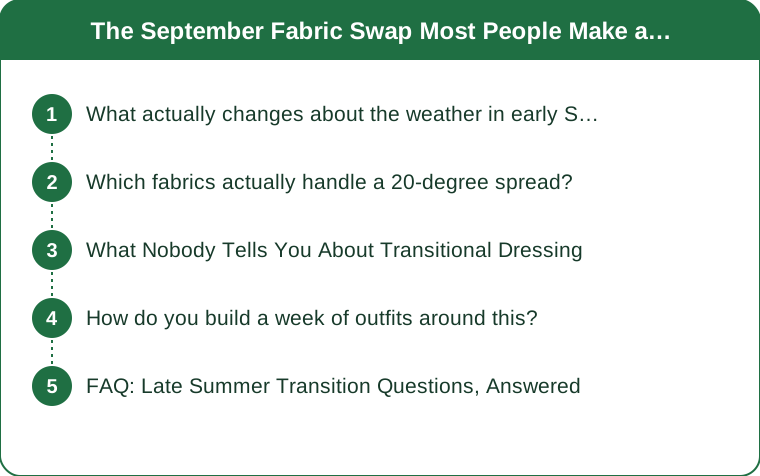
What actually changes about the weather in early September?
Less than the store displays suggest, and differently than you would expect.
The afternoon high barely moves. In most of the US, early September afternoons are within a few degrees of late August. The heat has not gone anywhere; the marketing has.
The morning low drops noticeably. This is the real change. The overnight low falls faster than the daytime high, which is why a 60-degree morning can turn into an 84-degree afternoon. That daily spread — not the absolute temperature — is what makes dressing hard.
Humidity falls. This one gets ignored and it matters most. Drier air means sweat evaporates faster, which means the same fabric feels cooler at the same temperature. Clothing that was barely tolerable in August humidity is suddenly slightly too airy at 8am.
The sun angle changes. Lower sun means shaded streets are genuinely cooler while direct sun is still strong. You now have two microclimates on the same block, which is why you can be uncomfortable twice in one ten-minute walk.
The correct response to all of this is not insulation. It is fabric that behaves well across a range instead of optimizing for one end of it.
Which fabrics actually handle a 20-degree spread?
The ones that adapt rather than the ones that insulate.
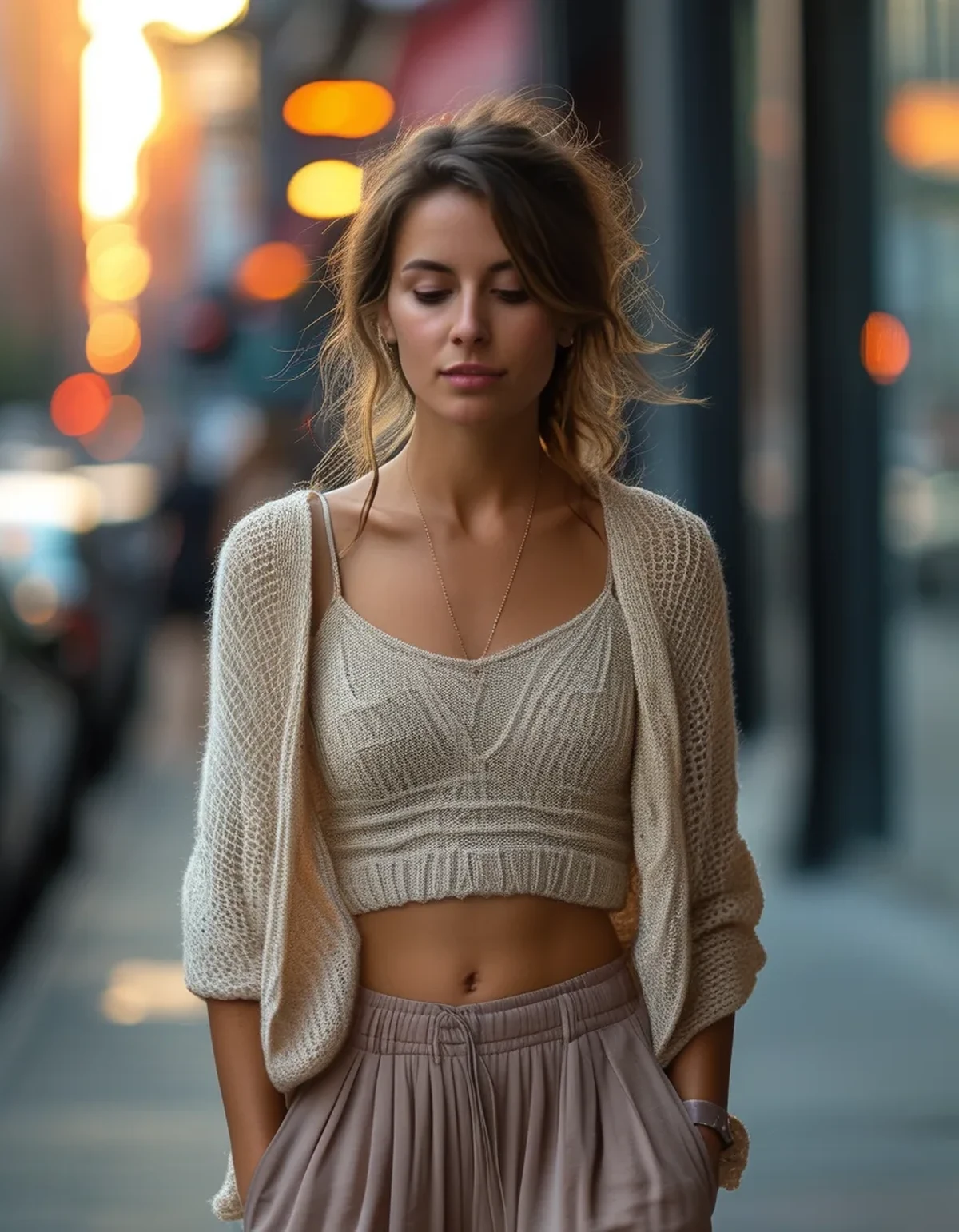
Fine merino is the standout. A lightweight merino tee or long sleeve regulates across a genuinely wide temperature range, handles a cool morning without overheating in the afternoon, and does not develop odor over a long day. It is the single highest-value transitional purchase and the one most people only associate with winter.
Tightly woven cotton over open-weave cotton. A poplin or a fine jersey holds a small amount of still air against the skin, which is enough for a cool morning, while an open-weave gauze or a loose linen lets every breeze straight through. Same fiber, same weight, completely different behavior at 60 degrees.
Ponte and interlock knits. Denser knit structures give you a stable, smooth surface with a little insulation and a lot of recovery. This is why ponte trousers feel right in September and wrong in July.
What to move to the back of the closet: open-weave linen, gauze, mesh panels, and anything with a deliberately airy structure. These are optimized for shedding heat, which is now only half your problem.
What to leave in front: anything that felt slightly too warm in August. That garment is now correct.
What Nobody Tells You About Transitional Dressing
One layer beats two thin ones in early fall. Layering is the standard advice, but two thin layers you cannot remove separately is worse than one correct layer. The layering answer comes into its own once mornings drop below the mid-50s.
The layer you remove has to go somewhere. A cardigan you carry all day is a cardigan you resent. If your commute has no bag, choose a fabric that works at both ends instead of a layer you will be holding.
Color reads seasonal faster than fabric does. You can wear the exact same silhouette into fall by shifting the palette — swapping bright white for cream, or pastel for a deeper tone — without changing a single thing about weight or breathability. This is the cheapest transitional move there is.
Your feet decide more than your top half. Closed shoes with a thin sock read as fall and add almost no heat. Sandals read as summer regardless of what you are wearing above. If you want to feel seasonally correct without cooking, this is the lever.
Sun protection does not end in September. The UV index in early September is still substantial, and the third mistake people make is dropping sun-protective layers exactly when the lower sun angle puts more of it on their face and forearms.
How do you build a week of outfits around this?
A small set of pieces that repeat, which is the whole point of a transitional capsule.
Two fine merino or high-quality jersey tops. One short sleeve, one long. These are the workhorses and they will carry you from now into November.
One mid-weight bottom in a dense knit or a woven with body. Ponte trousers, a heavier-weight legging, or a straight-leg trouser in a tight-weave cotton. Full length rather than cropped, since ankles are what get cold first in the morning.
One unstructured overshirt or light jacket. Not a sweater. A layer you can wear open, wear closed, or tie, and that looks intentional in all three states.
Closed shoes with a low-profile sock. The seasonal signal that costs no warmth.
A scarf, surprisingly early. A light scarf handles a cool morning better than a whole extra layer does and takes up nothing in a bag. It is the highest ratio of warmth to bulk in the entire wardrobe.
Skip for now: heavy knits, boots, anything lined, and anything that only works below 65 degrees. Those are for a month from now, and buying them in early September is how they get worn twice.
FAQ: Late Summer Transition Questions, Answered
When should I actually pack away my summer clothes?
Later than the stores suggest and earlier than you will want to. A practical rule: once you have gone two full weeks without reaching for a piece, it can go. In most of the country that means genuinely summer-only items leave in early October, not early September.
Is it worth buying transitional pieces, or should I just wait for fall?
Transitional pieces are the highest-use items in most wardrobes, because they cover roughly four months a year across two seasons rather than one. Fine merino, a good overshirt, and a mid-weight trouser earn their cost several times over compared with a heavy sweater that gets eight weeks.
How do I stop being cold in the morning without being hot at lunch?
Pick your outfit for the afternoon and add one removable thing for the morning — a scarf, an overshirt, or a light jacket. Dressing for the morning and hoping to adapt at noon fails, because you cannot add breathability to a garment you are already wearing.
TL;DR:
- Early September is drier and more variable, not colder — the daily spread is the actual problem
- Swap fabrics at the same weight: fine merino and dense knits in, open-weave linen and gauze out
- One correct layer beats two thin ones until mornings drop into the mid-50s
- Closed shoes and a color shift make an outfit read as fall without adding any warmth
The transitional wardrobe is not a lighter version of your fall clothes. It is a smarter version of your summer clothes, and the swap costs far less than the sweater you were about to buy.
Keep Reading
This article is for general informational and styling purposes only. Fit, sizing, and product availability may vary.