The Late-Summer Shoe Problem: Sandals Are Wrong and Boots Are Worse
Quick Answer: The shoe that works right now is closed at the toe, open somewhere else, and unlined. Loafers, mules, low-profile trainers and closed-toe flats all handle a cool morning and a warm afternoon without committing to either season. Boots are a mistake until the afternoons stop hitting the high seventies, and sandals stop working the moment your feet are cold on the commute.
One shoe, both temperatures.

Why is footwear the hardest part of this transition?
Feet cannot layer. You can add and remove a jacket six times a day. You are wearing one pair of shoes from the moment you leave until the moment you get home, and it has to work across a 25-degree swing.
Feet register cold before the rest of you does. They are the furthest point from your core and the first to feel a cool morning, which is why sandals stop feeling right well before the weather actually turns.
But they also overheat fastest in an enclosed shoe. A lined boot at 80 degrees is genuinely uncomfortable within an hour, and it is not fixable during the day.
Shops are three months ahead. Every window is showing knee-high boots in August, which makes people buy for a season that has not arrived and then wear it too early.
And the ground temperature lags the air. Pavements hold heat well into September, so the surface you are walking on stays warmer than the morning air suggests.
What actually works for these four weeks?
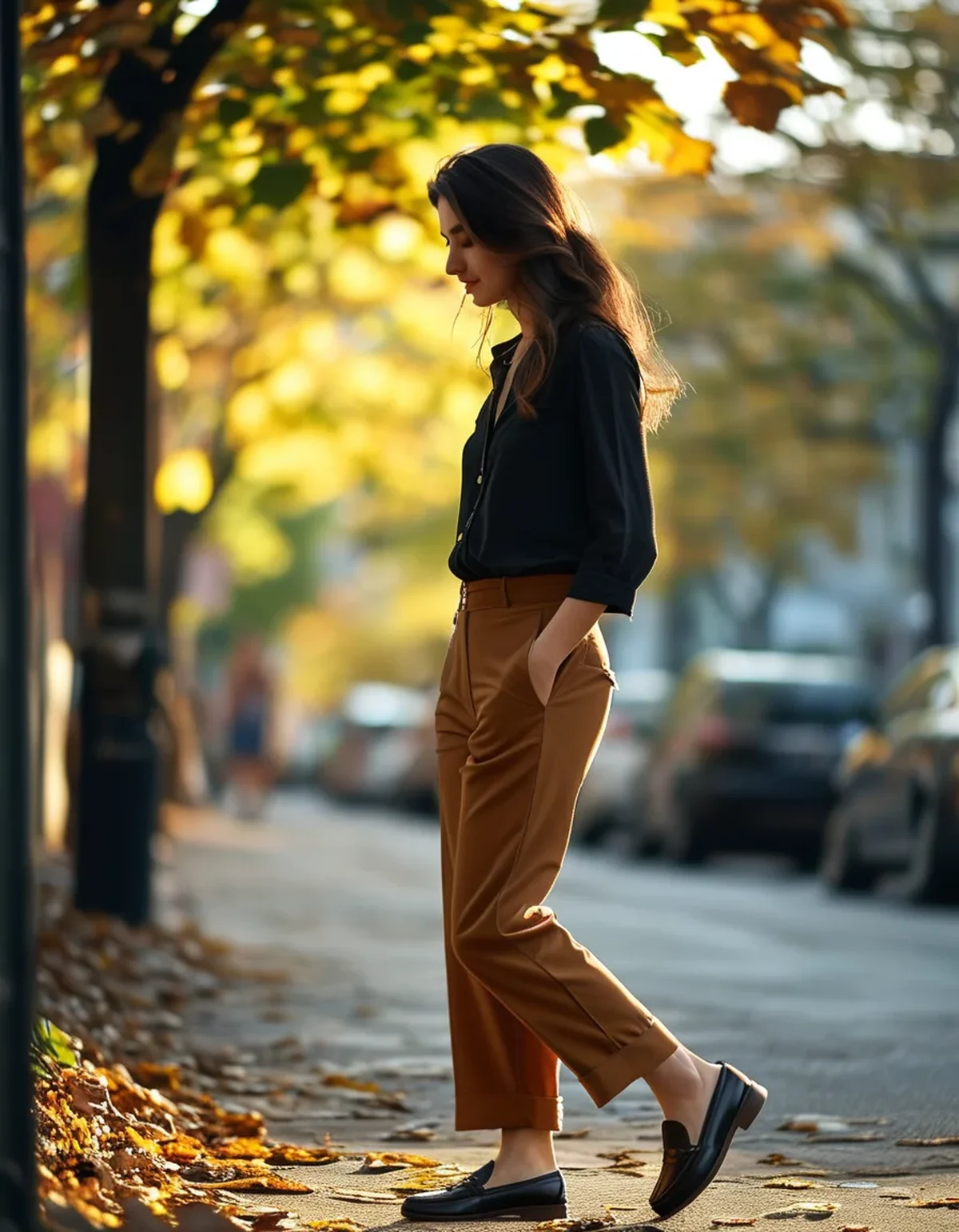
Loafers are the single best answer. Closed toe, unlined, easy to walk in, and they read as autumn without being warm. They also work with the cropped trousers and midi skirts you already own.
Mules solve it from the other direction. Closed at the front, open at the back — warm enough for a cool morning and ventilated enough for a warm afternoon.
Low-profile trainers stay useful, particularly in canvas or leather rather than mesh. Mesh reads as summer and lets in the morning cold.
Ballet flats and closed-toe pumps work for anything smarter, with the caveat that they are the least forgiving on a long walking day.
Ankle boots in unlined leather are the earliest boot you can justify, and only once mornings are consistently below about 60 degrees. Suede is even earlier visually and much worse in unexpected rain.
And keep one pair of sandals accessible for the days that go straight back up to 85. This is not the moment to pack them away.
What about socks, and everything below the ankle?
Invisible socks change the calculation entirely. They let you wear a closed shoe on a cool morning without it looking or feeling like winter, and they make loafers viable on days you would otherwise reach for sandals.
Visible socks are a styling decision, not a temperature one, and they read strongly as autumn. Fine for October, early for August.
Bare ankles are the transitional signal. Cropped trousers or a midi with a closed shoe and no visible sock is the exact look this season is built for, and it works at both ends of the temperature range.
Watch for the blister problem. Feet that have been in sandals all summer are not conditioned for enclosed shoes, and the first week back in loafers is reliably uncomfortable. Break them in on short days.
Feet also swell in the heat, which means a shoe fitted in a cool morning can be tight by three in the afternoon. Buy and test in the afternoon.
And check the sole. Summer soles are thin, and thin soles on cold pavement transmit cold directly. A slightly thicker sole extends a shoe’s season by weeks.
5 Mistakes Everyone Makes in the Shoe Transition
Switching to boots on the first cool morning. One cold morning is not a season. You will be carrying them by noon and regretting it by two, and the afternoons are still going to hit the eighties several more times.
Packing the sandals away too early. Late summer produces at least two or three more genuinely hot days after everyone has moved on mentally, and having nothing appropriate for them is a self-inflicted problem.
Buying suede in early autumn. It looks exactly right and it is the worst possible material for the season with the most unpredictable rain. Leather and treated fabrics survive; untreated suede does not.
Ignoring how much you actually walk. A shoe chosen for how it looks in a photo and worn for 12,000 steps is a bad afternoon, and this is the season with the most walking because the weather is pleasant.
Wearing summer shoes with autumn clothes. The fourth and fifth mistakes compound: a heavy knit with flat summer sandals reads as confused rather than transitional, and the shoe is doing more of that work than the top is. Match the weight of the shoe to the weight of the outfit.
And the bonus: buying one pair to solve everything. Two versatile pairs in rotation carry you through the whole transition far better than one perfect compromise.
FAQ: Late Summer Shoe Questions, Answered
When can I actually start wearing boots?
When afternoon highs are consistently below about 70 and mornings below 60. In most temperate climates that is late September into October rather than August.
Are open-toe shoes really over once September starts?
No — that is a convention, not a rule. If it is 84 degrees, open toes are appropriate regardless of the date.
What is the single most useful pair to buy right now?
An unlined leather loafer in a neutral colour. It works from late August through November, it goes with almost everything, and it handles both ends of the daily temperature swing.
TL;DR:
- Feet cannot layer, so the shoe has to work across the whole day’s temperature swing.
- Closed toe, unlined, and open somewhere else: loafers, mules, low-profile trainers, closed-toe flats.
- Invisible socks and bare ankles are what make closed shoes work in warm afternoons.
- Boots wait until afternoons are consistently below 70; keep sandals accessible for the hot days still coming.
- Buy and try shoes in the afternoon, when your feet are at their largest.
Stop dressing for the season the shops are selling.
Keep Reading
This article is for general informational and styling purposes only. Fit, sizing, and product availability may vary.