Dressing for 75-Degree Mornings and 60-Degree Evenings: The Layering Math for Workouts
Quick Answer: Dress for the temperature 15-20 minutes into your workout, not the temperature at the start — your body heats up fast once moving, so a layer that feels perfect standing still at 60 degrees becomes overheating gear ten minutes in. The fix is one thin, packable outer layer over a moisture-wicking base, so you can shed it once you’ve warmed up and still have it for the cooldown when your body temperature drops back down.
Late summer mornings that start crisp and cool but climb 15 degrees by the time you’re done are one of the most annoying dressing problems in outdoor fitness — too many people either overdress and end up carrying a sweaty jacket for three miles, or underdress and shiver through the first mile. There’s an actual system for getting this right.

Why Is a 15-Degree Swing Such a Genuine Styling Problem?
A 15-20 degree range covers real physiological territory. At 60 degrees standing still, most people feel just barely cool enough to want a layer. But exercise raises your core body temperature and skin temperature significantly within the first 10-15 minutes — a moderate-intensity workout can make you feel like the ambient temperature is 10-15 degrees warmer than it actually is, purely from your own metabolic heat output. That’s why a jacket that feels exactly right at the trailhead at 60 degrees can have you sweating and wanting it off by minute twelve, even though the actual air temperature hasn’t changed yet.
Then, on the other end, if your workout runs long enough to carry you from a cool 65-degree morning into a warmer 75-degree window, the opposite problem hits — what felt like the right base layer at the start starts to feel too warm, and the direct sun exposure (which climbs faster than air temperature as the morning progresses) adds real heat load on top of that.
The core issue is that a single, fixed outfit can only be “right” for one point on that temperature curve. Any outfit chosen for the start will be wrong by the middle; any outfit chosen for the middle will be wrong at the start or the end. That’s not a failure of planning — it’s just the nature of a 15-degree swing. The solution isn’t a smarter single outfit, it’s a system that can change with you.
What Makes a Layering Piece Actually “Packable” vs. Just Bulky?
Not every lightweight jacket is genuinely packable — the real test is what happens once you take it off mid-run or mid-hike and need to carry, tie, or stash it without it becoming a nuisance for the rest of your workout.
Compressibility is the first real marker: a genuinely packable layer should scrunch down small enough to fit in a running vest pocket, a waist pack, or comfortably tie around your waist without bouncing. This usually comes down to fabric — thin, tightly woven nylon or a fine-gauge knit compresses far better than fleece or thicker brushed fabrics, which stay bulky no matter how you fold them.
Weight matters almost as much as bulk. A layer under roughly 6-8 ounces disappears when tied around your waist or stuffed in a pocket; anything heavier starts to feel like dead weight bouncing against you for the rest of the session, which discourages people from actually shedding it when they should.
A packable pocket or stuff sack built into the piece itself is a genuine convenience feature, not a gimmick — jackets designed for this often fold into their own chest pocket, turning into a compact bundle with a clip loop, which is meaningfully easier to manage mid-run than trying to tie sleeves around your waist while moving.
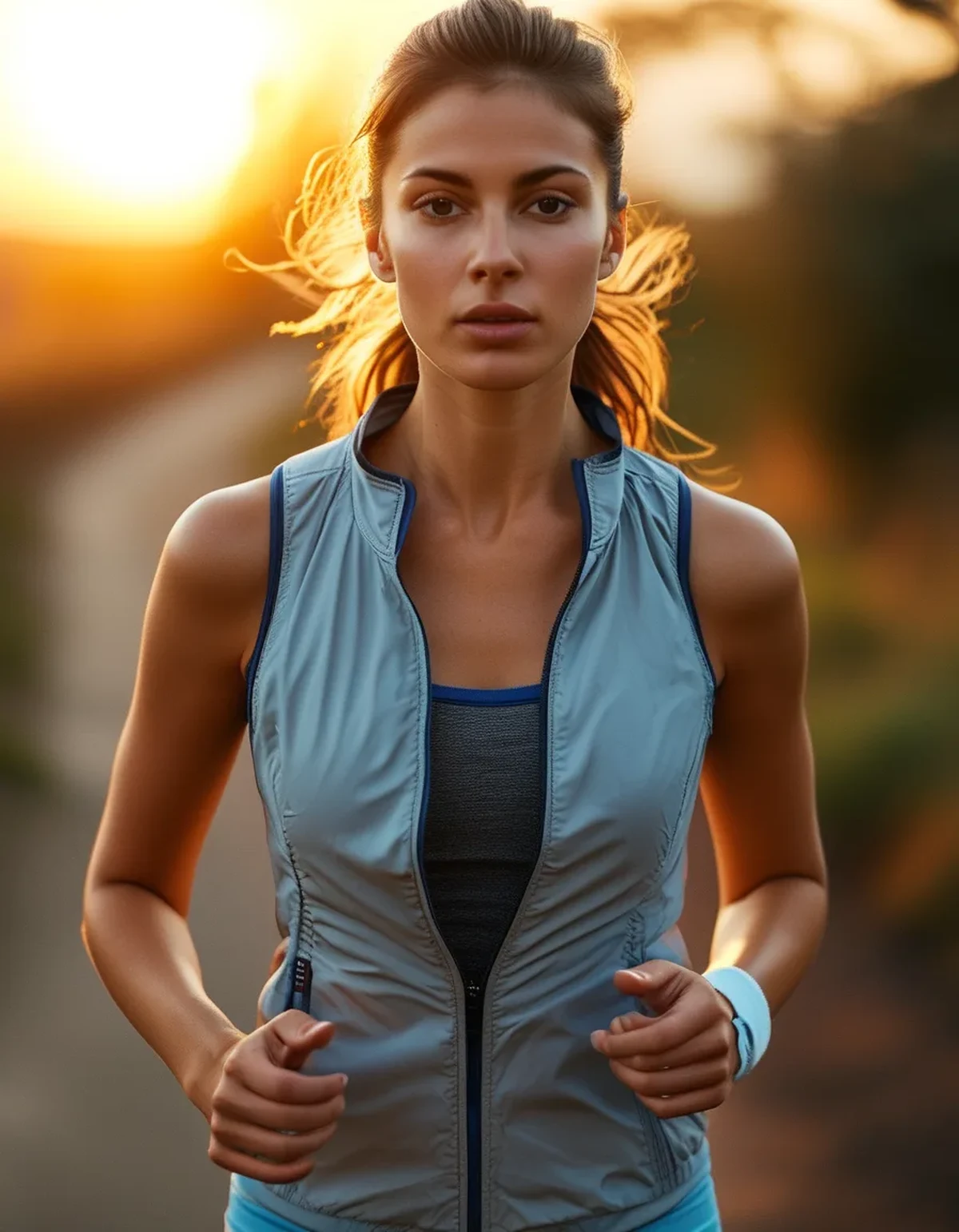
Quarter-zips and vests are worth calling out specifically for this weather range — a vest gives you core warmth without adding sleeve bulk to tie or carry, and a quarter-zip lets you dump heat through the neckline without fully removing the layer, which is useful for the messy in-between minutes when you’re not sure if you’re done warming up yet.
Which Fabrics Actually Regulate Temperature Across a Range?
The base layer (the piece against your skin) does more temperature-regulation work than most people give it credit for, because it’s managing moisture, not just warmth.
Moisture-wicking synthetic blends (polyester, nylon with elastane) pull sweat away from skin to the fabric surface, where it evaporates — this evaporation has an actual cooling effect on your skin as your workout heats up, functioning as a built-in thermostat that a plain cotton base layer can’t replicate. Cotton, by contrast, absorbs sweat and holds it against your skin, which feels fine in cool conditions but turns clammy and chilling fast the moment you slow down or the temperature drops in the evening — this is the actual mechanism behind why cotton is a poor choice for anything with a temperature swing built in.
Lightweight merino wool is worth knowing about specifically for this weather range because it has a genuinely unusual property: it regulates temperature in both directions, pulling moisture away like synthetics while also retaining a small amount of insulating warmth even when damp, which most synthetics don’t do. It performs well across a wider temperature band than almost any other fiber, which is exactly the problem a 15-degree swing presents.
For the outer layer, a wind-resistant but breathable shell (not a fully waterproof, non-breathing rain shell) handles the “cool start” problem best — wind chill is often the actual discomfort at 60 degrees, not the ambient temperature itself, since even a light breeze strips heat off exposed or lightly-covered skin fast. A wind-resistant layer blocks that without trapping the heat and moisture a fully sealed shell would.
Myth vs. Fact: Should You Dress for the Start or the Middle of Your Workout?
Myth: You should dress for how the weather feels when you walk out the door — if it’s chilly at 6am, bundle up accordingly.
Fact: The well-established rule among outdoor endurance athletes is to dress as though it’s about 15-20 degrees warmer than the actual starting temperature — meaning you should feel slightly under-dressed and a little cool for the first 5-10 minutes standing still or walking to your starting point. If you feel comfortable and warm standing at the trailhead, you are almost certainly overdressed for what you’ll feel like once you’re moving.
This feels counterintuitive because those first few minutes are genuinely a little uncomfortable — but that discomfort is temporary and self-correcting as your body heats up, while the discomfort of overdressing (overheating, excess sweat, a jacket you now have to carry) lasts for the rest of the workout and doesn’t self-correct until you physically remove a layer.
The one exception: very short workouts (under 20 minutes) or activities with long static portions (stretching, warm-up drills, group starts with waiting time) don’t generate enough sustained heat to make the “dress slightly cold” rule pay off — for those, dressing closer to the actual starting temperature is more comfortable throughout, since you won’t get the extended heat-generation window to offset the initial chill.
Does Timing Your Workout Change the Layering Math?
Yes — and adjusting when you go out is a genuinely underused tool compared to just adjusting what you wear. In late summer, the temperature curve from a cool morning to a warm midday is usually steepest in the two to three hours after sunrise, meaning a workout that starts at 6am and one that starts at 8am on the same day can have meaningfully different in-workout temperature swings even though the starting temperature might only differ by a few degrees.
Starting earlier generally means a smaller swing during the workout itself (you’re moving through the coolest, most stable part of the morning) but a colder starting temperature to dress for. Starting a bit later means a warmer, more comfortable start but a bigger swing if your workout runs long, since you’re now moving into the steepest part of the morning warm-up curve.
For workouts longer than 45-60 minutes specifically, timing your route matters as much as your layering — planning a route where the last 10-15 minutes bring you back toward shade, water, or your starting point (where a bag or car with a change of layers is waiting) solves the “I’m too warm but don’t want to carry this jacket for another 5 miles” problem better than any fabric choice can.
The practical version of this: check the hour-by-hour forecast, not just the daily high and low, and pick your start time based on how much of the temperature climb you want to spend moving through versus starting in.
FAQ: Temperature-Swing Workout Layering Questions, Answered
What’s the single most useful piece to own for this exact weather pattern?
A lightweight, packable quarter-zip or vest in a wind-resistant (not fully waterproof) fabric, worn over a moisture-wicking base layer. It solves the cold start, packs down small enough to tie or stash once you warm up, and adds back a small amount of warmth for the cooldown if evening temperatures drop again.
Should I wear gloves or a hat for a 60-degree start?
Extremities (hands, ears) cool faster than your core and don’t benefit from the same exercise-generated heat your torso does, so light gloves or a headband are reasonable even when your torso layering follows the “dress 15 degrees warmer” rule. These are also easy to stuff in a pocket once you’ve warmed up.
Is it better to wear one heavier layer or two lighter ones?
Two lighter layers almost always outperform one heavier layer for this weather range, because layers give you an adjustable system — you can shed one and keep the workout comfortable, whereas a single heavier piece is all-or-nothing.
How do I handle the cooldown if the temperature has already dropped by the time I finish?
This is exactly what the packable layer is for — the piece you shed 10 minutes into the workout goes back on the moment you stop moving and your body heat production drops, since post-workout is when you’re most likely to feel a chill even if the air temperature hasn’t changed much.
TL;DR:
- Dress for how you’ll feel 10-15 minutes into the workout, not how you feel standing at the start — exercise adds the equivalent of 10-15 degrees of felt warmth fast.
- A genuinely packable layer is defined by compressibility and low weight (under 6-8 oz), not just being “lightweight” on the hanger.
- Moisture-wicking synthetics or merino wool as a base layer do real temperature-regulation work through evaporative cooling — cotton actively works against you in a temperature swing.
- Adjusting your start time changes the size of the swing you’ll experience just as much as adjusting your outfit does.
Two light layers and a slightly cold first mile beat one heavy layer and a jacket you’re stuck carrying for the rest of the run.
Keep Reading
This article is for general informational and styling purposes only. Fit, sizing, and product availability may vary.